
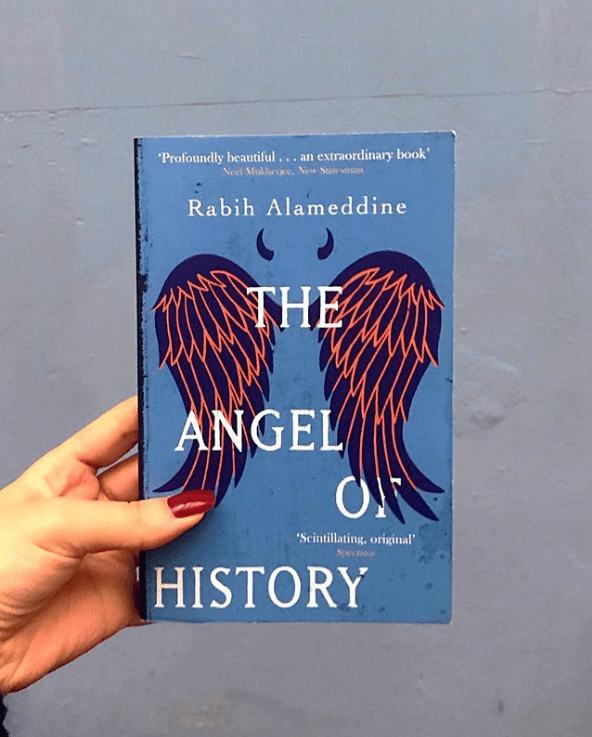
I learned about Rabih Alameddine, Lebanese-American painter and writer (and so much
more), through social media a while back (IG @beirutiguy). I didn’t even know he was a
writer, just a quirky individual with a relatable sense of humor. You can imagine how happy I was to find his name printed on one of the books I picked up at the library. And my happiness still as that book turned out to be everything I never knew I had been searching for.
“While I were alive, I loved you while you were alive, and I loved you still, but I forgot for a while.
Forgive me, I couldn’t obsess about you all the time, so you disappeared as if I’d bleached my memory.”
The Angel of History walks us through the life of Yemeni-born Jacob (Ya’cub) in reminiscence while he awaits his turn in the psych’s waiting room, trying to recall suppressed events and the last days with his dead lover.
Narrated by both Jacob and a sassy Satan who cares for him, we revisit the time he spent in Yemen, then in a whorehouse with his mother in Cairo, then under his father’s wealthy wing in Beirut, up until his time living in San Francisco as a gay Arab man at the height of AIDS. In an interview, Alameddine mentions that he became a writer to reflect his own experience as a gay Arab man in America at the height of AIDS.
I’ll be honest, I’ve been at a loss as to how to go about this. One of the reasons is that Alameddine is a protégé of the mixture between prose, politics, humor, literature, religion… The book has everything, references to other works and events in the Arab world are everywhere.
It’s not an easy read but a magnificent one nonetheless.
“I gave up home, I gave up, when Mubarak was pardoned by the military government, with each
bomb that Assad dropped on his people, with each suicide bomb in Baghdad or Benghazi, in
Barca or Cyrene, a razor blade cut through another vein. I bled whatever pride the revolution
had engendered. Hope might be the thing with feathers but in the Middle East we hunt those
birds for sports.”
The biggest challenge is to understand the time, space and discourse; the book throws us between
the Jacob of the past, the Jacob speaking to his dead lover, Satan interviewing saints about Jacob
and Satan speaking directly to Jacob. However, it wouldn’t take long to grasp the writing style
and once you do, you’re hooked till the end.
Alameddine brought to light the dormant, the angry, the secret duality of my identity.
On peaceful days, it’s easy to get lost in the Westernization of my homeland, and with the
privileged, it’s easier still to internalize different values than our neighboring countries.
Underneath all the symbolism and prose, there is a story of naked yearning and despair that
forces readers to relate and feel the raw emotions of the protagonist. By the end, I was overwhelmed by the need to protect, hug and forever care for Ya’cub.
The Angel of History is a poem, a play, a painting and a revolution masked as a novel.
Enjoy and always bring a book home. x

 Bring a Book Home